Thick and thin cultures 🐘

Chris Arnade on X (Feb 14, 2026):

… for the U.S., our thick culture is largely inherited from Western Europe, mostly England, and is best summarized as Careerist Protestant Christianity—a prosperity theology manifest as the American Dream, which synthesizes a moral order built on the Ten Commandments, overlaid with a heavy dose of Lockean individualism and Enlightenment rationalism. Thin culture gets all the attention, but it is the thick culture that makes a nation and determines its long-term path.

The US is unique (and arguably successful) because it has a high acceptance for a lot of thin cultural differences — as long as you buy into the thick culture. That is, you can live how you want, as long as you ultimately believe in making mint through hard work and playing by the rules.

Or, thick culture is the plot we follow, and thin the stage settings.

This concept of “think and thin cultures” can also be seen in:

# 12:08 / culture, usa

How to make a living as an artist 🐘

One of the better blog posts I have read in a while. Going into depth about the motivation, and how to practice the “trade” etc.

Being an artist always seemed like “not-a-job”, and appeared to me like something fueled by motivations different than those animate people to hold a job or non-pecuniary reasons. This blog does a good job of uncovering that layer of ashes.

Another thought I have been mulling over the past few days is — You must develop your own unique view of the world. Find the “gold” seam, a unique perspective that gives you a leverage over one more affairs of the world. Art, original art is definitely a unique perspective of the world.


web archive link

# 07:02 / art, essays

Finders, Minders, and Grinders

I read this tweet:

“Finders, minders, and grinders” Partners, VPs, and analysts

And it was a new perspective on how organizations are structured. I googled it and found this article which goes further into how professional (in this case legal) firms identify, and develop different kinds of people even though they all start the same way.

The expression “Finders, Minders and Grinders” is attributed to David Meister in his book Managing the Professional Service Firm.

Finders are the rainmakers. Minders are the ones that manage the teams and deliverables. Grinders are the ones that do the work. This blog introduces the idea of Binders - people that network, nurture relationships.

Looking from a technology worker perspective, most of the people fall into the “Grinder” set. This seems almost insulting to technical people, but it is not difficult to see why many “professionals” outside the tech bubble see all tech people as grinders, even if the t-shirt wearing, unkempt “techy” might be worth many times the well dressed striver in a “professional” organization.

The lesson for those in the technology world is understand — there IS a difference between the archetypes, with the Partners being the real movers, and shakers. A lot of the ambitious tech people aspire toe be Minders (managers, VPs, etc).

If you can teach yourself to look at the big picture, you might want to be a rainmaker.

You need to be original, and you cannot borrow someone else’s brain to get there.

# 14:22 / organizations, mental-models

Software's first act is over 🐘

AWS’s Marc Brooker offers a sober view of the evolving split in the road for software development career.

 The slow end of programming as an economic discipline, as weaving, ploughing, and coopering went before. It is reasonable and rational to feel a sense of loss, and a sense of uncertainty. With the loss of the craft comes the loss of the economic moment where that craft was valued beyond nearly any other.

Craft was valued beyond nearly any other — At least since the turn of this century, software jobs were the veritable gold mines of making over the top money, even if you were slightly ambitious, and worked your way into high paying jobs. That is already gone.

But new ideas, real transformative new ideas, remain hard to come by. And, as the lever gets longer, more and more valuable.

We haven’t seen this yet through the haze, and the dense fog of the present, but we need to be patient, and keep looking for that lever.

Nothing wrong in refusing the touch “AI” because there will be still work for those want to do it the “old way”.

The stubborn who stick to the old ways, and hustle to squeeze out the remaining economic value. That value will remain, because the world always changes slower than we would like.

Many fields only change through the death of the current crop of “experts”, and software is no different.

But one this is for certain — Software’s first act is over.

# 21:24 / vibecoding

More Codex-like Apps

Yesterday (Feb 2, 2026), OpenAI announced their Codex App for managing multiple coding agents.

This space (desktop agents) has seen a lot of entrants. So far:

  • Conductor - Run a team of coding agents on your Mac — “Run a team of coding agents on your Mac. Create parallel Codex + Claude Code agents in isolated workspaces. See at a glance what they’re working on, then review and merge their changes.”
  • Emdash — “Open-source agentic development environment. Code purely by orchestrating agents. Run multiple in parallel, each isolated in their own Git worktree.”
  • Codex Monitor - Orchestrate Codex agents across your workspaces — “Monitor your Codex situation. Orchestrate any number of Codex agents across any number of projects in a beautifully crafted command center for threads, reviews, and worktrees.”
  • Commander - Native Mac AI Coding Assistant for Claude Code & Codex — “A native macOS interface for Claude Code and Codex with built-in diffs, git workflow, and worktrees—prompt, review, and commit without context switching.”

Of these two, I’ve only installed Codex and Commander. Still using CLIs as the primary agentic interface.

Commander is a native MacOS application. Rest of them are Electron apps, with codex Monitor being a Tauri app (less bloating).

# 07:30 / vibecoding, macos

Vibe coding is the new product management. Training and tuning models is the new coding.

You might demur, it’s one of those pithy Naval sayings, but it is food for thought nonetheless — if the LLMs are failing in your domain, you wait for the model to get better, OR you pull up your sleeves and see if you can improve the model by tuning it.

Can you just not fix the broken code generated by LLM? you ask. The keyword here is “vibecoding”, which implies you are generating most of your code without going through the LLM’s output line by line. So, in order to figure out what’s wrong, you have to read it all - which is putatively against the vibecoding ethos.

If you consider coding agents to be your assistant, you want the assistant to get better over time without you having to step in and fix the messes all the time.

Right now, tuning is quite the esoteric art. Perhaps, the next jump in building trust with coding agents will come from making the tuning process tractable for working programmers.

While there are, and will be, many programmers who will never trust LLM to do what they do, developing confidence in guiding the LLM to make improvements will take vibecoding from “good for throwaway code / good for demo code”, to something broader in scope for developers that have an open mind about use of LLMs in coding.

— naval

# 06:06 / vibecoding

Welcome to the room 🐘

Congratulations… your days of whining are over.

In this room, we deliver success, we don’t whine.

Look, I’m not confused, I know you walk through fields of shit every day.

Your job is to find the rose petals.

Don’t come whining that you don’t have the resources you need.

We’ve done our homework.

We’ve evaluated the portfolio, considered the opportunities and allocated our available resources to those opportunities.

That is what you have to work with.

Your job is to manufacture success with the resources you’ve been allocated.

And yes – you have a hard job.

You only have 2 controls:

  1. The clarity, culture, and energy you give your teams; and
  2. Resource allocation.

And I want to be clear with you.

If you are in this room, you need to deliver outsized success.

To do that, you will need to allocate resources ahead of conventional wisdom​.

Conventional wisdom will generate conventional success and that won’t allow you to stay in this room.

You need to have courage and be bold.

And when you do that, you may fail.

BUT.

If you fail, I will back you if, and only if, you are “intellectually honest”.

Intellectually honest means: 2) You always have a plausible theory of success. 3) You allocate your resources in accordance to that theory 4) You monitor your theory 5) When you find it is no longer plausible, you make changes to get a new plausible theory of success.

If you are doing these things, I will back you even if you have a failure… As long as you don’t make it a habit.

(Satya Nadella’s address to his senior exec team, as shared by Jeffrey Snover)

# 15:06 / management, algorithms-for-life

Coding Agent VMs on NixOS 🐘

With the popularity of exe.dev, sprites (from fly.io), and shellbox, one wonders if there is a way to give sandboxed environment on existing, local boxes without having to pay for a cloud hosted service?

Michael Stapelberg lays out one such possible solution using NixOS and microvm.nix.

Another interesting addition to this space is nanoclaw that uses Apple Container to provision Linux containers on MacOS.

Between the two, the microvm.nix is appears to be handy for provisioning reproducible, complex, and repeatable containers (think if you are trying to provision hundreds of openclaws.. say as a service provider), while the nanoclaw, is good for your own personal (1) setup. Apple Container also feels very handy for provisioning throw away containers. The example on the README shows a good example.

# 11:40 / vibecoding, macos, nixos

Seek Delight

“What do you want [out of life]?”

The answer often is - Happiness, Contentment, Wealth, Health. Pursuit of any and all of these is valid.

I want to add DELIGHT to that list.

It is so much exciting to seek and find delight. It is also a great attitude — you can choose to be delighted at things instead of just of “ho-hum”ing.

# 10:47 / algorithms-for-life

How I am using Clawdbot (Moltbot)

Moltbot fka ClawdBot has been the rage among generative AI enthusiasts for the past few weeks, and I too have been caught up in it.

Simply put, it is what “smart AI assistant” can look like. You tell it things, it figures out a way to do it. You give it “tools” and access to data, it can figure out more things.

This is what Apple Siri should / could have been at the very least.

There are plenty of articles out there telling how to set it up, and how those individuals are using it. So, I’m not trying to write one more of those. With this post, and following ones, I want to capture how I have been using Clawd^HMolt.

I talk to moltbot over WhatsApp.

One of the first thing I did was to use Molt as a my daily link/read-later aggregator. I share links throughout the day using whatsapp. I have instructed molt to present all of them to me in a digest at 7pm.

In addition, I have given access to my pinboard with an API key. The daily summary also includes links saved there.

I have also told molt to send me a couple of daily “motivations” at 7am. These are things I want to remember. For example: “Seek Delight!” :)

I wanted to use email. mostly by forwarding some of my emails to a dedicated account molt has access to and use the top-quote text as instructions to molt. But, setting up an email is such a pain these days. Gmail has made it very difficult. Still figuring that out.

More to come.


WOWZA! Moltworker: a self-hosted personal AI agent from Cloudflare

# 10:31 / moltbot

The Stable Marriage Problem 🐘

Ajeya Cotra goes into the “Stable Marriage Problem” algorithm to explain why Asking for what you want opens up you to opportunities that may be outside your usual band of possibilities.

… I think the core dynamic in the proof of asker-optimality and askee-pessimality does apply to real life. If you only ever pick from offers you get, you never try anything unless someone out there already knew you and liked you enough that they took the trouble of coming to you. If you ask for stuff, you get to pick from among the entire universe of potential options theoretically available to you — and who knows, it might work out.

In my own personal experience, I can count many, many things I have gotten by asking, even (especially) things in retrospect, I had no business of having. However, it is always good to remind ourself that it is a muscle that atrophies if you don’t exercise frequently. So, go ahead, and ask away!

# 16:04 / algorithms-for-life

Lessons learned are quickly forgotten unless they were learned in terror, or sorrow, or shame. Wisdom can always be rented for free, but it must be purchased with pain.

Without courage to be afraid, sad, subject to ridicule, there is no learning.

Courage must start with yourself. Having the courage to tell yourself what you are afraid of, telling yourself something that challenges doesn’t fit the idea of who you are. It is going to be painful, do it anyway.

— G S Bhogal

# 06:21

Reliable Signals of Honest Intent 🐘

This is a great phrase — “Reliable Signals of Honest Intent”, one that you should be reminding yourself every time you are making something for “others” to see/consume/approve/buy/appreciate.

In the current atmosphere, where everyone is drowning in an attempt to keep up with rapid, exponential changes in AI.

Why are we all doing that? Is it just to have fun? Is it to signal that we are current? If so, to whom? and whatever you are doing - doing side projects, writing LinkedIn listicles, doing yet another MOOC, getting another certificate, prowling grad school websites to see if you should get another MS or an MBA, or start a side hustle that might get acqui-hired.. The list of things we conjure to signal are endless, and they all take a lot of energy.

I think it is important to stop, pause and consider — who are we signaling to? what is the signal we are sending? and more importantly — *is what I am doing A Reliable Signal of Honest Intent?

Time is finite, things to learn/do are, well, infinite. An ounce of clarity, an hour of planning, a spoon of taste, an earful of listening carefully to what people(users/buyers/investors/what-have-you) are saying might help calm the nerves, make targeted bets, that have higher odds of working out.

More than all that, a reliable signal is something that takes something from you. It is not cost-free. If you haven’t put your skin in the game, sweat in the brow, and metaphorical blood in the soil, your effort may be hardly better than someone else’s AI generated slop at worst, or someone’s couple hours of noodling.

The bar has definitely jumped a couple of stories high. It is disorienting to have to adjust to the new expectations. But, this is how it has been for many professions.

Going back to the original subject of Sutherland’s  “Alchemy: The Surprising Power of Ideas That Don’t Make Sense” — largely about marketing and consumer psychology, it is a dark art for people who are not in that profession. But, almost everything that is made, sold, and consumed in the capitalistic system is made possible through what he calls the “Alchemy” of synthesizing ideas that appeal to humans.

We, the technologists, have among our midst, many such mavens that understood human psychology very well (e.g: Steve Jobs). But, it is no longer sufficient that one in 10,000 is good that stuff. Perhaps, we all have to get 10x better at persuasion, and it is hard to do that without producing signals that are very hard to ignore.

Produce more reliable signals of honest intent.
# 21:49 / mental-models

Targeted Bets 🐘

The biggest takeaway from reading “Poor Charlie’s Almanack” is that the late great investor Charlie Munger preached the importance of having, acquiring, and applying mental models.

Lot of success comes down to identifying how to increase our odds in a crowded marketplace where many are vying for the same pie. This post by Sean Muirhead provides good insight in a terrible job market (2023-ongoing).

The biggest takeaway for me is that you need to be intentional, and think hard about what is that I want? Even if it is - I just need a job, I don’t care which (many people say this, but there is always a “but” when you listen), sending resumes to blackholes and keeping fingers crossed has not worked at all for much of the people on the market.

Sean’s mental model of targeted bet is applicable for much more than just job hunt, and it definitely gave me a pause and prompted me to reconsider my approach to how I am going about my current job search.

After coming back to US from India after in mid 2024, I was in the boat of “I need a job right away”, and I was lucky enough to find a job that is very close to where I lived, in a respected organization, doing something that is currently hot (Generative AI), as well tap into my experience. I am currently on the lookout, attempting to leverage my experience into a robust role where I can make a bigger impact.

I will be making targeted bets.

# 21:37 / mental-models

IU Hoosiers are College Football Champions

Indiana University Hoosiers Football team won the National Championship today defeating Miami Hurricanes after their toughest match of the playoffs.

With this win, they are 16-0 for the season - undefeated. This is one of the unlikeliest, heart-warming Cinderella stories in any sport I’ve followed.

I only started following them late in the season, IIRC the first game I watched was the one against Maryland (55-10) in Nov 2025. I did watch a couple since then - against Oregon, PSU, OSU and all the playoff games.

# 23:55 / indiana, football

A new era for static site generators

I am no stranger to static site generators, having written a few of them (bari) myself(mdninja) over the years (webgen.py) and of course something I wrote and used for a long time — sitebuild, which powered my site www.btbytes.com for many years. I often considered them to be “Hello World” programs of the 2010s, and even continuing into 2020s, going by there was a post on lobste.rs this week about yet another SSG someone wrote.

What made static site generators really attractive to me, and I guess many other programmers, is:

  • I don’t want to learn some one else’s system.
  • Usually they are too big or too small
  • They don’t have the features I want without .. again learning their system
  • and the problem seems simple enough that you can make it up as you go

But what awaits you on the other side is, a lot of ticky-tacky work, and a system that is never polished enough compared to some of the long term bloggers like - Simon Willison, and Justin Searls, and Daring Fireball(though, a customized version of MovableType) who all have their home grown systems.

This is where LLMs, and AI Coding agents really change the landscape (like they are doing everywhere).

I “vibecoded” this site entirely using Claude Code (to begin with), and Codex (when I ran out of Claude tokens), and most recently with OpenCode (mostly MiniMax 2.1) as I mentioned earlier. This time I didn’t start with a blank slate but instead started with Astro.JS, eschewed using any pre-made templates, or blogging frameworks built on top of Astro.js, and decided to write it myself with the help of coding agents. Having written HTML, CSS, JS and all other parts of website for 20+ years, I had strong opinions on what I wanted.

The experience of building this site can be approximated to having a very good developer that understands everything I know and can produce code exactly (or even better) as I wrote in my “prompts”. You can see them here on gist.github.com

This is no different than chatting with a developer on the other side of the continent.

While I picked the coding agents to write a silly old static site generator, because it is a domain very well known to me, you can chosen some other software (maybe a 2D game, or a data visualization project) and had similar experience.

It is a good time to be a programmer, even though you may be lot, lot less code than you used to, but you are writing more code, and ploughing through your project backlogs.

# 15:45 / vibecoding, staticsitegen

Observed on the stream

A hard kettlebell workout routine; 2:32 video, 20 minute workout. NP and I had a Kettlebell coach (Darrell, who has 10 kids last I checked his FB page), and we would have our sessions one after the other because one of us had to watch the kid. My session was first and NP would hand off S to me, and I would take her home. Weather permitting I’d take S to the Monon Trail. The kettlebell studio was in the now torn-down strip mall in the corner of City Center Dr and S Rangeline Rd in Carmel.

—

Interesting thread on a edible mushroom cultivator in Chicago by patio11. Doordarshan (India’s public TV broadcaster) often used to air a documentary on mushroom cultivation and I used to pester my dad that we should get into cultivating mushrooms since it looked so interesting. I don’t think i was even a big fan of eating mushrooms back then.

—

A history of The Olivetti Company with pictures from Abort Retry Fail substack which chronicles the history of the computing industry. Found an interesting profile about Cirrus Logic and Suhas Patil, and wikipedia tells me he is the father of DJ Patil - who was the Chief Data Scientist (golden era of Data “scientists” one could say) in the Obama administration.

—

Sutskever 30 implementation is a collection of 30 Jupyter Notebooks that implement the papers listed in the Sutskever’s 30 papers list. See also PaperCode — a “leetcode” (training ground) for AI/ML models.

—

Molte the Elder a contemporary of Bismarck; also one of the first humans whose recorded voice is preserved (on wax cylinders).

—

The story behind Sponge Daddy (which we use at home). A great example of UX driven product development and then finding the product market fit, interestingly, he changed his product to appeal to a broader market (kitchen sink) than originally thought (workers’ hands).

—

A different kind of legacy — Top 100 Landowner List (I assume only cover USA) with some interesting notes:

Buck Family — A native of South Portland, Maine, PETER BUCK (1930—2021) studied at Bowdoin College before earning advanced degrees in physics at Columbia University. While employed at GE, Buck made the fateful decision to loan Fred DeLuca, the son of a family friend, $1,000 to launch Pete’s Super Submarines in Bridgeport, Connecticut. Buck also tendered a suggestion to his new partner: Study the culinary creations of Amato’s, a popular Italian sandwich shop at the corner of India and Newbury Streets near where Buck grew up. His advice and his investment helped to create Subway. Decades later, when the sandwich shop became a global powerhouse, Buck returned to his roots and invested a portion of his profits in Maine timberland, which now belongs to his heirs.

I also remember watching a video short on Ted Turner’s stewardship and conservation efforts of his lands, especially reintroducing the American Bison.

# 13:49

Coding is cheap, taste is not

What coding agents do is make exploring your ideas accessible even when you are not al all-rounder in design, coding, administration, and other tasks associated with making “something” involving software. It smoothes over gaps in knowledge, allows you to scale up much faster than ever before, it even short-circuits the chores like infrastructure, and speak nothing of the reduction in time, and fast iteration cycles.

As many who have been chasing the highs with turbo-charged coding agents have realized, keeping the coding agents fed, and humming all the time is very hard, and it is already the bottleneck for enthusiastic adopters of AI coding.

Yes! you have run through your idea backlog and built a lot of handy, cool, and even some really useful stuff that were on your yakshaves list, and at the very least you have built a ton of automation, and tools that will make your work easy, and enjoyable. But the real question for creators is - who else is going to use the stuff you are building? What will entice them to use it? What advantage do you have over thousands of other enthusiastic creators (not only limited to “coders” anymore)? Is it taste? is it the ability to sell the idea? is it access to a superior distribution channel? Whatever it is, the winners are going to be the ones that are actively in the arena - building, experimenting, talking to potential users, sweating the details, and keep growing the “big picture” in their heads.

Inspired by Agents make building cheap but taste is still expensive. post Jo Bergum.

I use “cheap” in the sense of being readily available.

# 09:44 / vibecoding

What you really care about is what you spend your time doing, not what you keep saying.

Vibe Coding this site

This whole blog is built with 99% vibecoding with Claude Code. I only used Codex couple of times in the last couple of days when I ran out tokens on Claude. Today I did things like

  • Add a Feed
    • Even a Kannada specific feed, though I’m yet to write a Kannada post.
  • Add unique ids to each paragraph and list using rehype. Each element will get a four letter hash unique to that page, so that I can link to individual paragraph anywhere on a page. Example
  • Add a 404 page entirely one-shotted, of course.
  • The entire styling has been reworked couple of times.. plain to lively to now muted, entirely using “Impeccable Style“‘s Claude plugin.

First Impressions of OpenCode

I should give Minimax 2.1 a try using OpenCode.

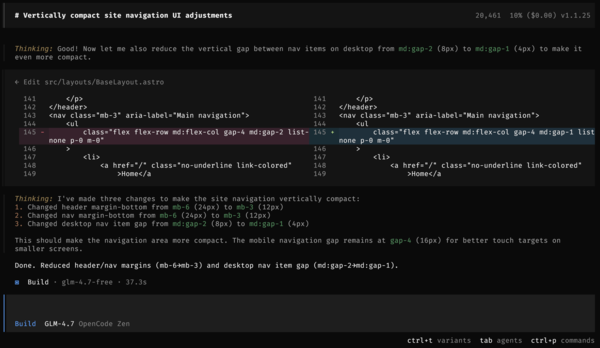
I ran out of Claude credits and started using OpenCode with GLM-4.7, which I think is “free”? with Opencode. The thinking mode output is lot more useful to understand what’s going on behind the screen.

GLM 4.7 output

I even figured out how to use Minimax-2.1. All I had to do was to sign up for a key on https://opencode.ai/.

AI Assisted Software Engineering

Writing a good software spec by Addy Osmani is a nice checkpoint in the ever evolving way of writing non-trivial software using AI Coding agents. It is very hard to be at the cutting edge of “vibecoding” because there are multiple frontiers developing at the same time, and not one person can claim to know the best way to do so. Best way forward is to ground ourself in the fundamentals of Software Engineering, and guide the tactics using tools that make sense to us in a given context.

See also Addy Osmani’s new book on AI-assisted Engineering — “Beyond Vibe Coding”

By initial looks at the article and the book website, this approach feels lot more structured than whatever Gas Town is kicking up. There are quite a few articles, and blog posts raving about Gas Town (and plenty of detractors at the usual sites). I am quite happy with whatever off-duty programming I’m getting done with Claude Code, and looking forward to bite off on a big enough project where Gas Town could be interesting.

Observations

Watched the AFC divisional between Bills and Broncos. Josh Allen in his 9th year is probably feeling lot more pressure on him than Peyton did before winning one at Indy in 2006 season (his 8th). Bills might consider a change at HC. Sean Payton’s Broncos played well enough to continue to enjoy their No 1 seed for another week. It grinds my gears (slightly) when people mess up the spellings of the former QB (“e”) and the HC (“a”).

—

Take out and eating out feels like a big waste of money 8/10 times these days. Expectations for a work-day lunch/dinner or while traveling have lowered expectations. But, going out for a proper dinner, dropping $200 and leaving the place feeling meh, is more common than ever. The tips recommendations in some of these places start at 22%, yeah no.

—

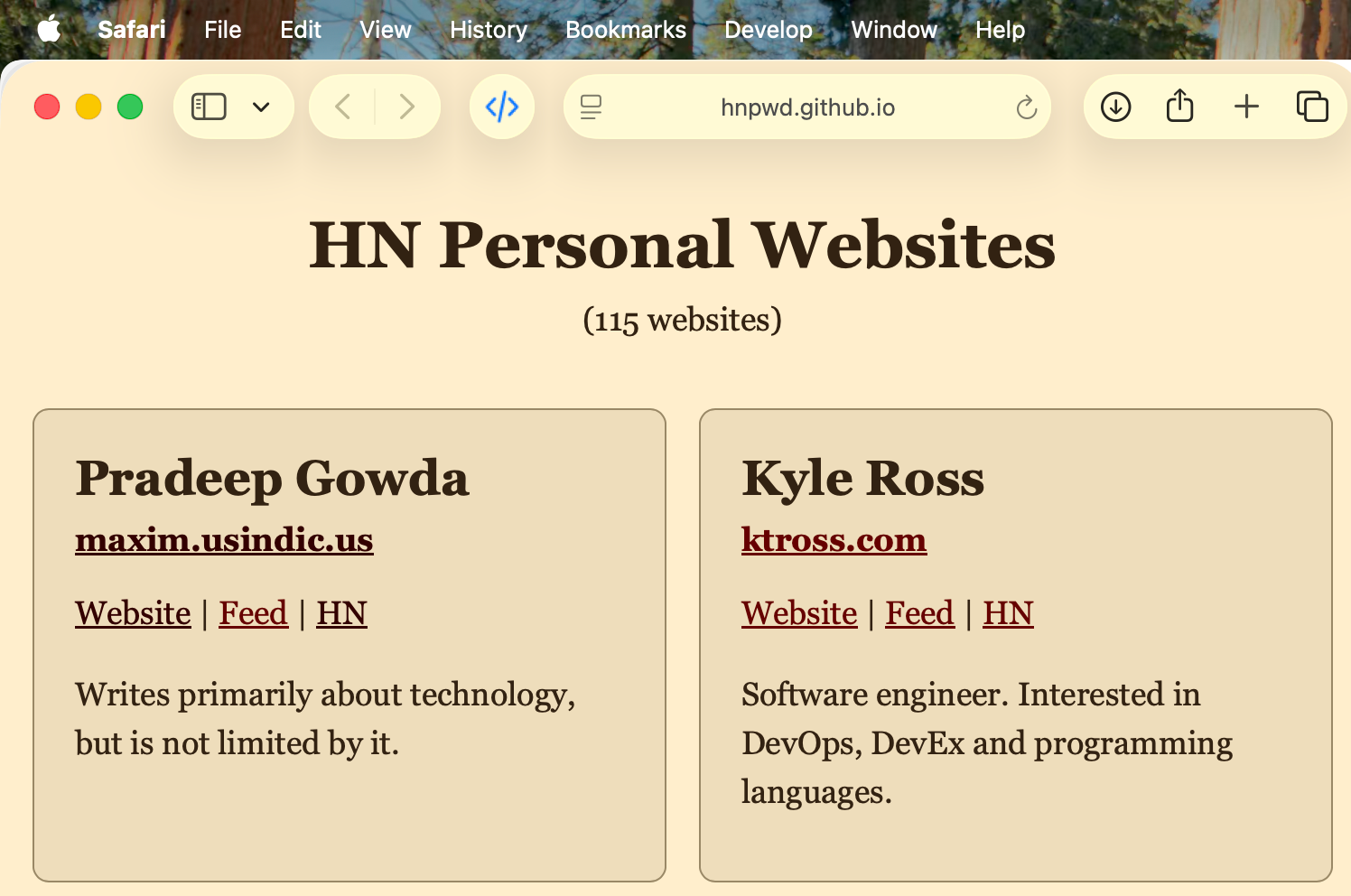
Added this site to hnpwd.

hnpwd

# 12:11 / vibecoding

Astro Joins Cloudflare 🐘

I thought I would resist the temptation to make the first post on this blog about the tools used to write this blog, but ironically, this news pushed me to finally stop polishing the apple and get the first post out.

I am generally (still) averse to Javascript, and Typescript programming; however, the framework at the top of the exceptions list is — Astro. I use astro to write this blog, and publish it on Cloudflare. I am very happy with this development because Astro finds reliable funding, and dedicated staff to work on Astro. You can manifest things into existence and you should try!

I have more to say about how I setup this blog, and how I went about coding this up, but that’s for another day, but for now I’m letting the cat out of the bag — the whole site was coded from the get-to using Claude Code, OpenAI Codex, and a tool that I only heard earlier in this week - Impeccable Style.

# 14:00 / cloudflare, astrojs